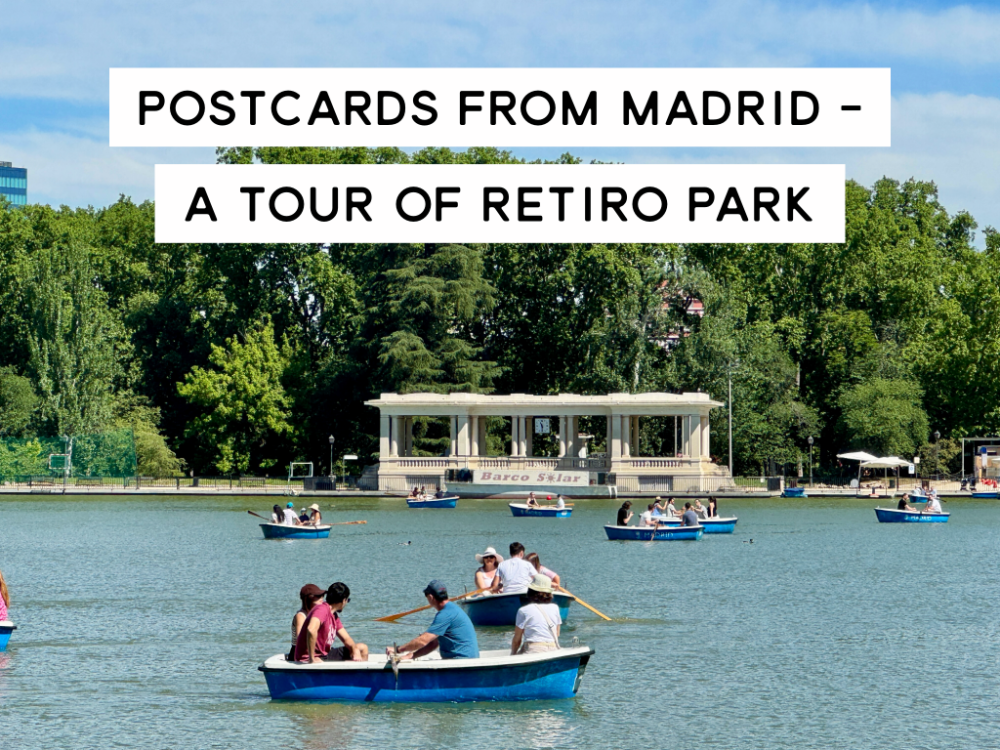
Retiro Park is one of those places in Madrid that you could easily spend a whole day exploring, so rather than joining an organised tour, we decided to try another self-guided VoiceMap tour. This isn’t our first VoiceMap rodeo. We did the Emily in Paris tour in, yes, you guessed it… Paris and the Secrets of the Medieval Jewish Quarter in Palma. A little tip: VoiceMap tours are cheaper when you buy them through the VoiceMap website rather than the app, so it’s worth checking the website before you book.
We really rate the VoiceMap tours and this one was no exception. Taking a Voice Map tour meant we could wander at our own pace, stop whenever we fancied, take photos and admire the views. Along the way, we discovered some fascinating history, a few bizarre stories and some of Retiro’s most famous sights. Come and have a wander around the park with us…
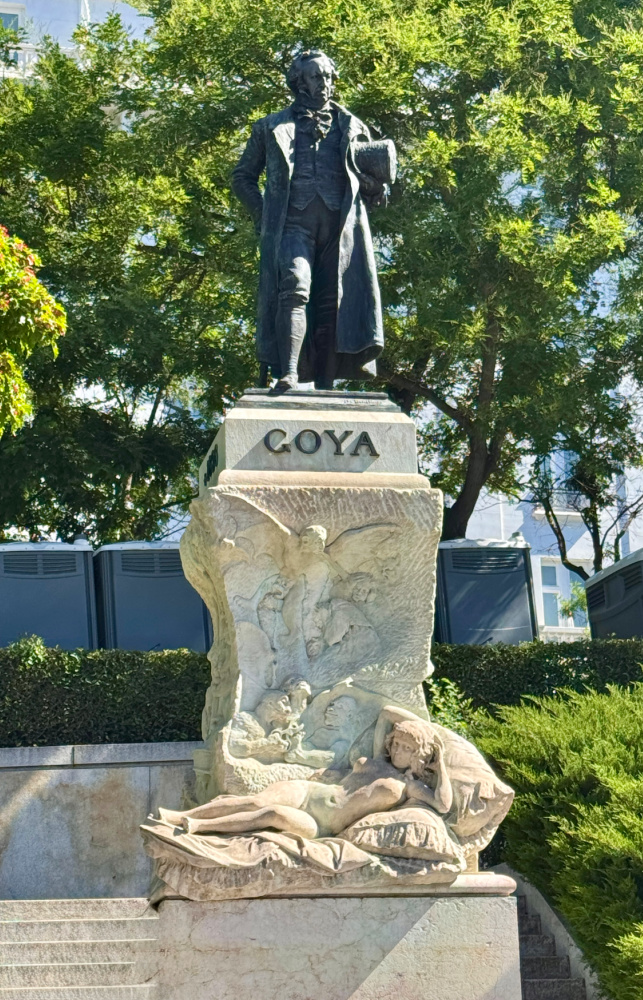
We start our tour of Retiro in front of the famous Museo del Prado beside the statue of Goya, the painter who famously got into trouble with the Spanish Inquisition over La maja desnuda, the saucy nude you can see at his feet. Before things went south, Goya was a painter to the Spanish court and his work, along with that of Titian and El Greco, to name but a few, now graces the walls of this world-famous museum. We don’t have time to go inside though, as we have a whole park to explore!
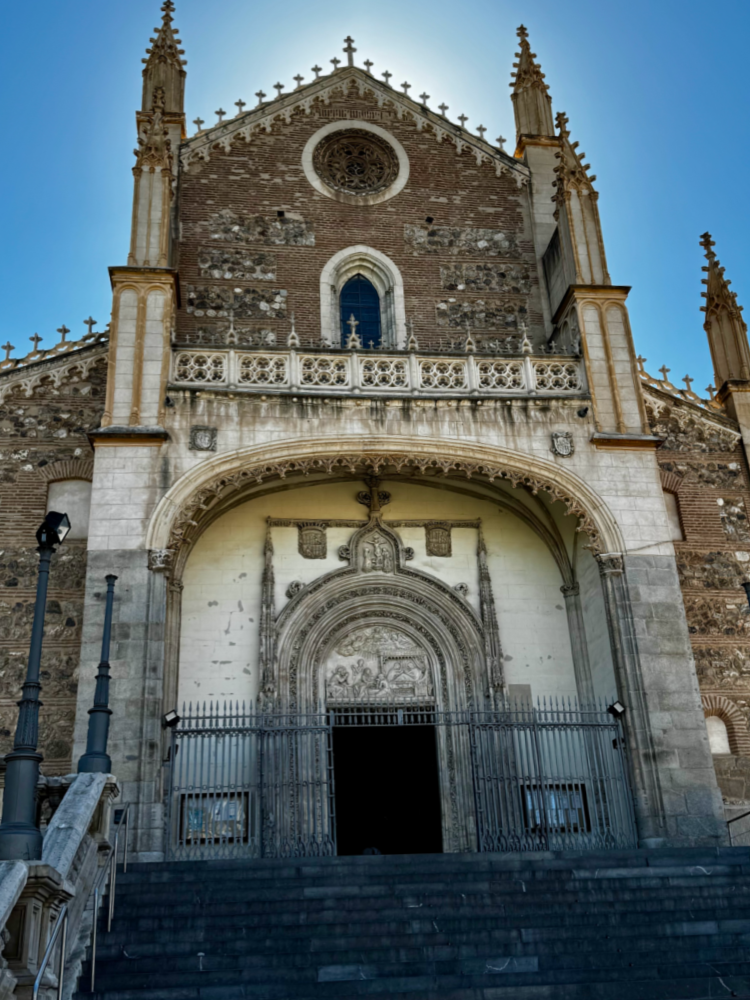
El Prado means meadow and this area, on the outskirts of Madrid was once a rural retreat for the Spanish court. Philip II came here to escape the hustle and bustle of the city and a few decades later his grandson, Philip IV, turned the area into the magnificent Buen Retiro palace and gardens. The church of San Jerónimo el Real is one of the few surviving remnants of that royal past, although its exterior has had more work done on it than a Hollywood celebrity! The monumental steps were added much later and were built for the ill-fated wedding of Alfonso XIII and Victoria Eugenia of Battenberg. And, in case you’re wondering, yes, she is part of the family that inspired the famous Battenberg cake!
The marriage got off to a rather unfortunate start. On their wedding day in 1906, as the newlyweds were travelling back from the church, an anarchist called Mateo Morral threw a bomb at their carriage. The royal couple escaped unharmed but 24 people were killed and more than 100 wounded. And that was just the beginning of the newlyweds’ misfortunes.
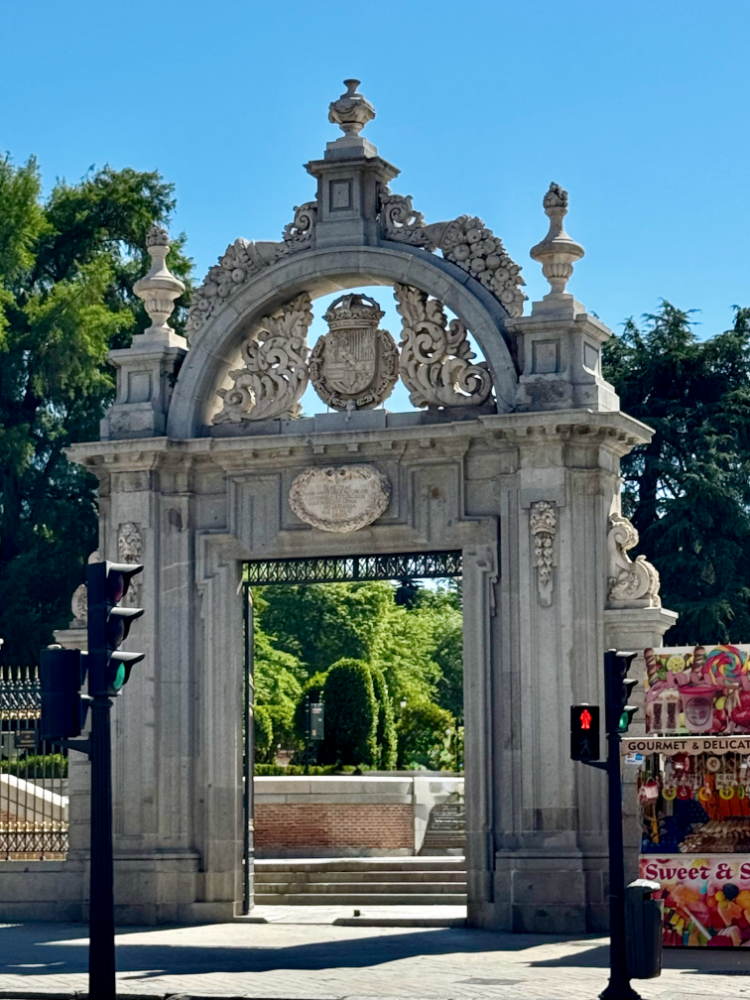
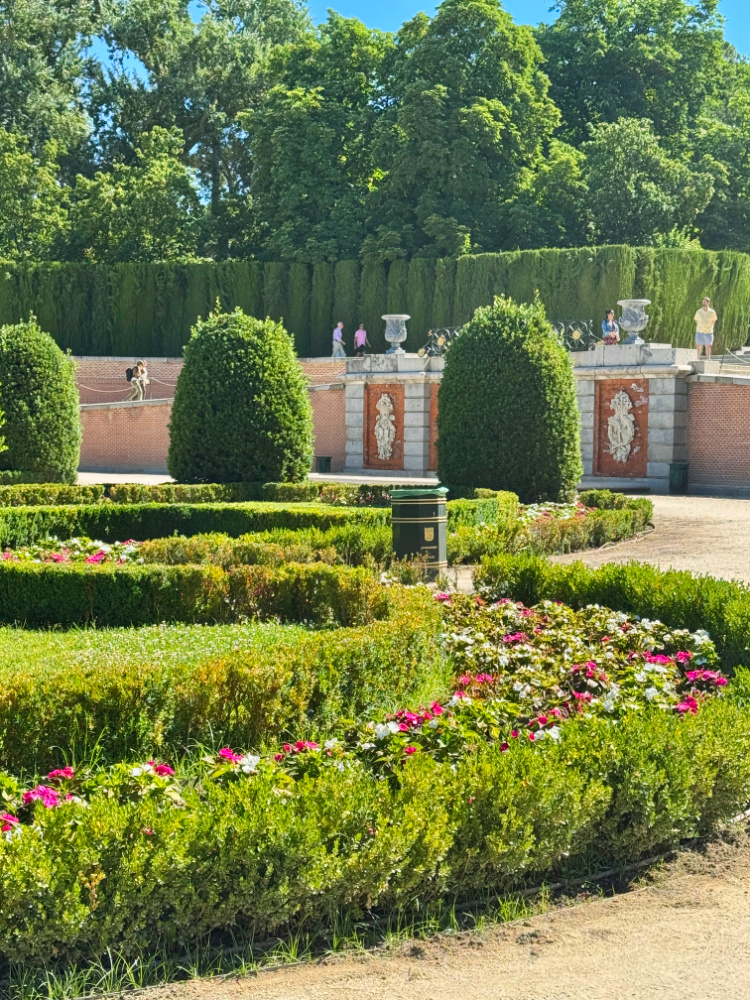
We enter the park through the triumphal arch known as the Gate of Philip IV. Built in 1680 under Charles II and covered in intricate stone carvings, it’s very impressive and leads us straight into the beautiful Parterre Garden.
With its neatly clipped hedges and formal flower beds, the Parterre Garden is an absolute delight. It’s such a lovely spot to wander through and even on a sunny day, there are plenty of shady spots to escape the heat.
It’s here we discover Retiro’s oldest tree, the famous Ahuehuete, thought to have been planted in 1632. The name comes from Nahuatl, the language of the Aztecs and this particular type of tree can live for hundreds of years with some examples reaching around 2,000 years old. Despite it’s relative youth, this tree is still the oldest tree in the park, surviving the French occupation of Madrid in the early 1800s when Napoleon’s troops camped out in the grounds and chopped down huge numbers of trees. Legend has it that the Ahuehuete survived because the French used its sturdy branches to support a cannon. Whether the story is true or not, one thing is for sure: the tree survived while much of Retiro was destroyed around it.

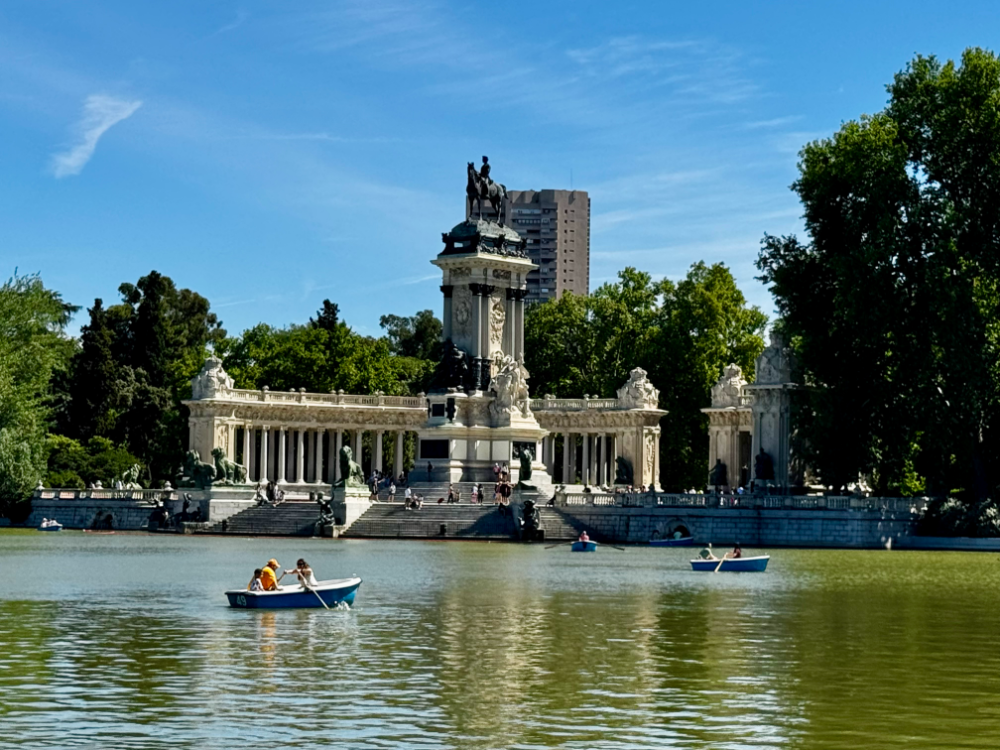
This boating lake is the last surviving part of Philip IV’s magnificent pleasure palace and back in the day, it had a small oval island in the middle where concerts and plays were performed while the king and his courtiers watched from their bougie boats. The court also enjoyed recreating naval battles on the lake because apparently watching a play wasn’t quite enough entertainment for a royal afternoon! These days you can take a much more modest boat out on the lake – they’re available to hire from the little jetty. However, be careful, when the lake was dredged for repairs in 2001 they found 50 mobile phones among a cornucopia of sunken treasure including a safe and a gobstopper machine!
Moving on, we arrive at Retiro’s public library, Biblioteca Municipal Eugenio Trias. The older brick part of the building is the former Casa de Fieras or House of Beasts which was once the park’s zoo. It’s a hot day, so we stop for a rest on the beautiful tiled seating completely unaware that this peaceful spot has a rather gruesome past.
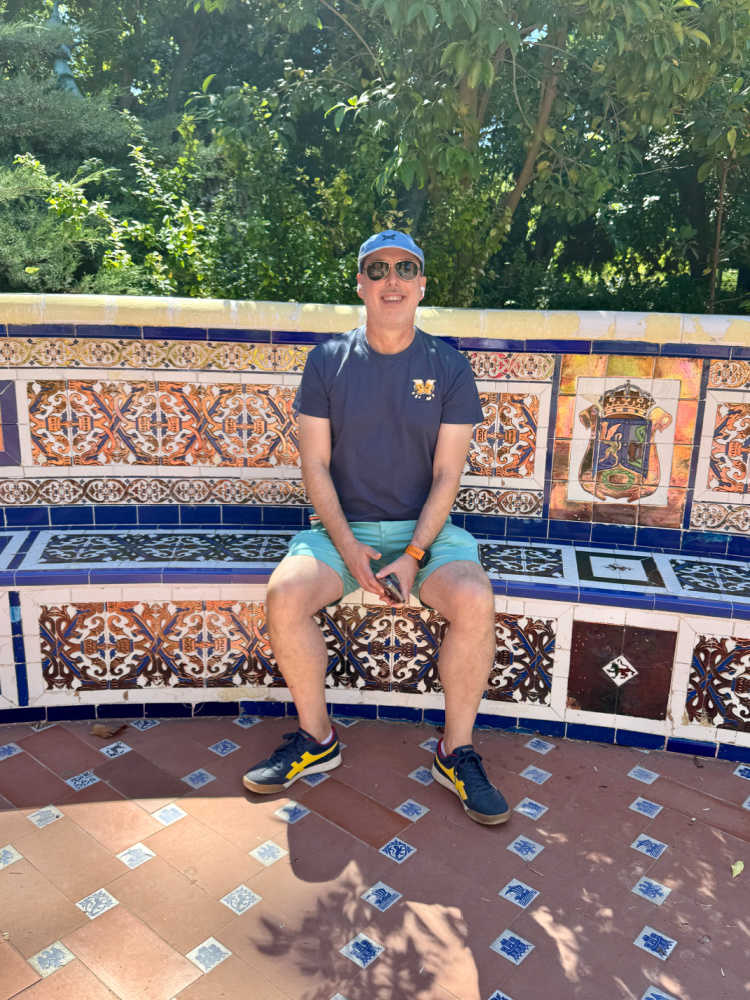
When the park was opened to the public in 1868, the zoo came under the management of the city and, from the 1880s, was run by a private contractor, Luis Cabañas. He had a taste for what we would now consider rather horrific entertainment, organising animal fights in which zoo animals were pitted against bulls. One of the zoo’s most famous residents was Pizarro, an elephant who was forced to take part in these fights and even lost a tusk. When she was eventually retired from fighting, Pizarro became a much-loved attraction and was taken to the park’s large pond for her daily bath.
In 1918 the city took back control of the Casa de Fieras and thankfully the animal fights became a thing of the past. The zoo’s conditions, however, remained pretty grim, with animals kept in increasingly cramped conditions.
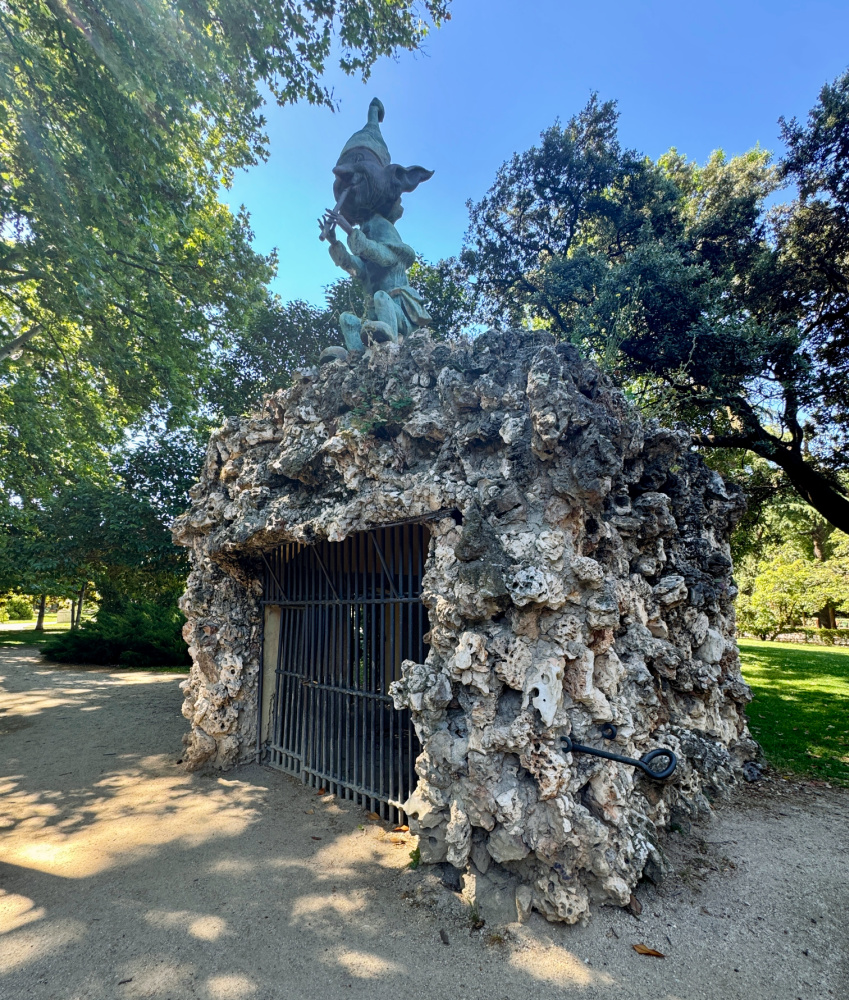
This was one of the original bear caves, and the poor bears that lived here had hardly any room to move. It’s hard to imagine keeping an animal in such a tiny space. On a slightly more cheerful note, the statue of the goblin playing the flute was added in 1985 and, according to legend, any couple who spots the statue together will be blessed with a long and intense relationship. Well, obviously we had to stop for a photo!
After the Spanish Civil War the collection grew considerably and, by the 1960s, the decision was made to move the animals to a much larger site in Casa de Campo. The new Madrid Zoo opened in 1972 and the Casa de Fieras was finally closed. Thankfully, these days the only wildlife you’re likely to see in Retiro is squirrels, cats, the occasional peacock and plenty of pups out on their daily walk.
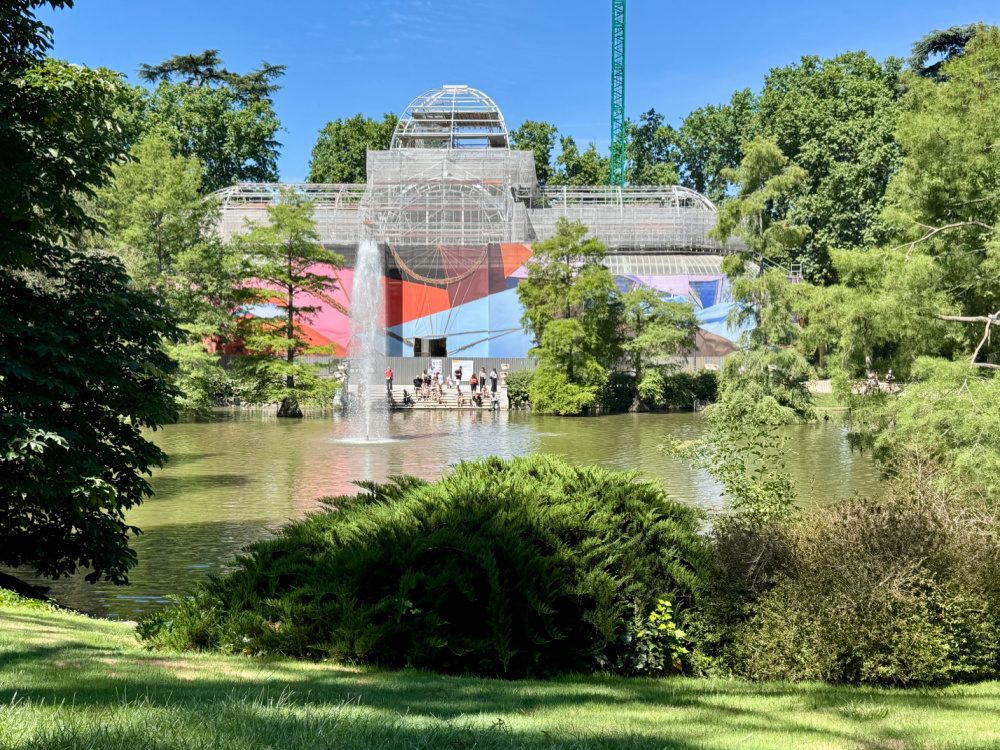
We make our way to the Crystal Palace built in 1887 to resemble it’s namesake in London. When it was built it was a marvel of engineering because it was quite a feat to make a curved glass roof. Recently the building has been found to be structurally unsound with some of the glass panels in danger of falling so work is currently underway to restore it to it’s former splendour and glory.
At the edge of the park, you’ll find one of the world’s few public statues dedicated to Lucifer. This is the Ángel Caído, or Fallen Angel, inspired by Lucifer’s fall from grace in John Milton’s Paradise Lost which I studied for A level, by the way! The sculpture was created by Ricardo Bellver in 1878 for the Paris World Fair and was subsequently acquired by the Prado before being donated to Madrid City Council and finding its final resting place here in Retiro.
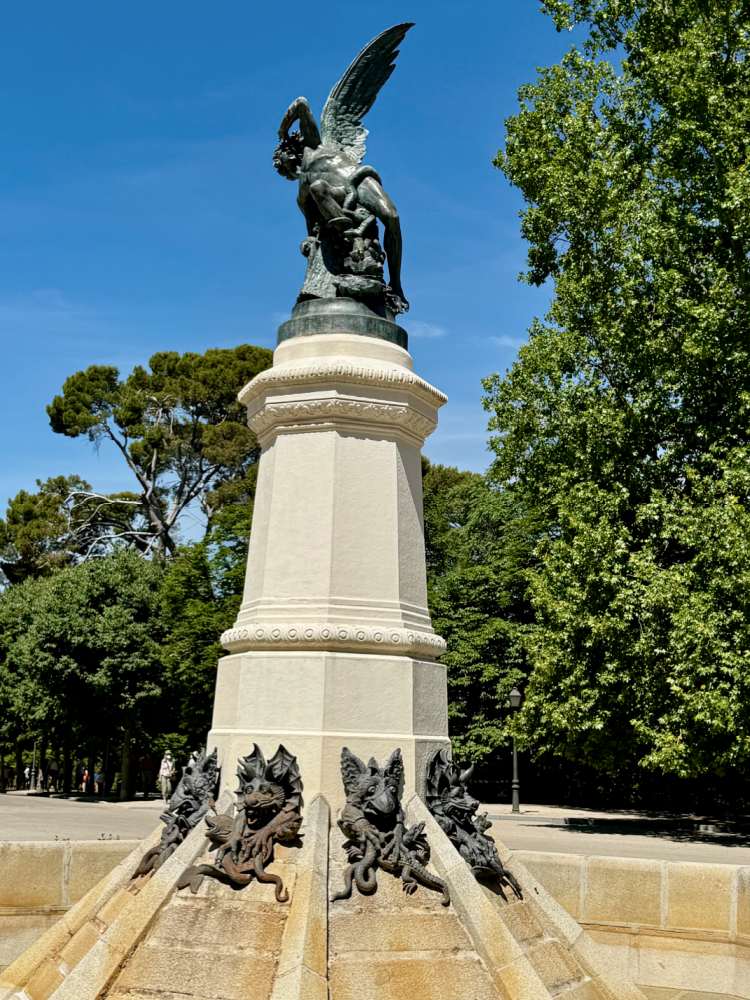
The rather fabulous pedestal was specially designed for the statue and, if you look closely, you’ll spot the grinning devils lurking around the base. And here’s the really fun bit: the statue is said to stand at exactly 666 metres above sea level. Coincidence? I think not! Madrid itself sits at around 665 metres, making it one of Europe’s highest capital cities, second only to Andorra la Vella.
And that, my friends, brings us to the end of our tour. I loved the fact that this VoiceMap tour gave us all the interesting history and stories without having to stick to someone else’s timetable. I’ve barely scratched the surface here. We discovered so much along the way, from a 400-year-old tree and a famous elephant to a flute-playing goblin and a statue of Lucifer!
If you’re visiting Madrid, I’d definitely recommend putting some time aside to explore Retiro. It’s beautiful, full of history and, as we’ve discovered, has more than its fair share of weird and wonderful stories. And if you fancy discovering it at your own pace, I highly recommend Felicity’s Voice Map tour.
Do you enjoy self-guided tours when you’re travelling, or do you prefer having a guide? And if you have visited Retiro Park, what was your favourite discovery?